Riflessioni
The Real Likeness Between Man and Machine Is Not Intelligence — It Is Indeterminacy
Published on 15 August 2026
The Real Likeness Between Man and Machine Is Not Intelligence — It Is Indeterminacy
Two indeterministic processes checking each other do not produce a deterministic result. They
produce a third indeterministic process.
And which is more indeterministic — the human, or the generative machine?
Subconscious and tokens are in fact decorrelated by construction, and therefore
destined for a productive collaboration rather than a redundant one.
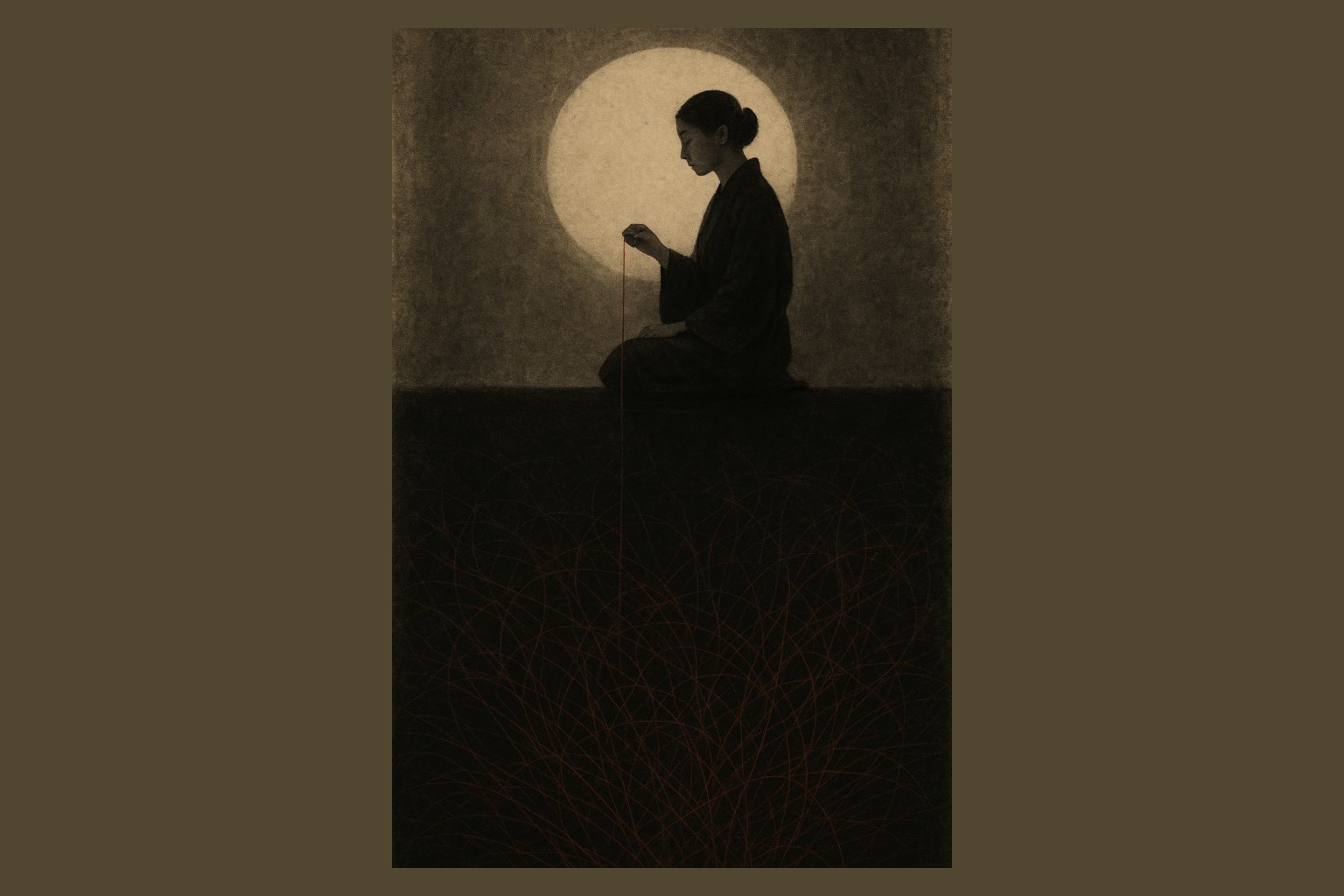
I had this painting made because I needed to explain something that I can never get across in words. I have been trying for months, and every time I watch the other person's attention slide away. Then it occurred to me that maybe the problem was not the listener: it was that I was using the wrong instrument.
What you see
The painting is cut in two by a sharp horizontal line. That is the threshold.
Below, for two thirds of the height, there is darkness — but not an empty one. It is crossed by hundreds of very fine red threads that intersect, knot and disappear. The deeper you look, the denser they get. It is not chaos: look a moment longer and you see arcs, wide curves, a weave. It is disorder with a structure.
Above, a seated figure, motionless, in profile, before a full moon. Between her fingers she holds a single red thread. That thread is one of the many below: it has crossed the threshold and reached the surface, where it is visible, where it is one and not a thousand, where someone is holding it.
What it means
The darkness below is the subconscious. Not the irrational or faulty part of us: the largest part, the one that processes without consulting us, that connects things we did not know we had connected. That is where the years settle — the reading, the trades, the mistakes, the people met. This is why the threads have a weave and are not noise: it is disorder that carries our history inside it.
The figure above is the conscious mind. What we call thinking, and which is the small part: one thread at a time, held still, looked in the face.
The threshold between them is what actually interests me. It is not a wall: it is permeable, and one thread crosses it. But something changes in the crossing. Below there are a thousand simultaneous possibilities; above, one remains, and becomes a decision. The gradient of indeterminacy is born there: in the number of things that could have risen, and did not.
Why it is not a flaw
We are used to treating unpredictability as a limitation to be corrected. In a system meant to produce reliable results, the instinct is to reduce it as far as possible.
But a fully predictable system has a property that is rarely said out loud: it cannot produce anything it was not already taught. It repeats. It repeats very well, tirelessly, and if it contains an error it repeats that too, forever, with great efficiency.
Everything that in my experience has been genuinely discovered — a fault found where nobody was looking, a diagnosis overturned at the last minute, a solution arriving from a trade that had nothing to do with the problem — came from down there. From a thread that rose without being summoned.
And then the hand
One detail holds the whole painting together: the hand.
The thread does not float. Someone is holding it. This is where the matter stops being about how the mind works and becomes about who answers for the outcome.
If the human node is the least predictable of them all — and it is — then we cannot justify its place at the top of the chain by claiming it is the most reliable. It is not. It is there for another reason: it is the only one that can answer for the result. Responsibility is not a technical property to be computed and shared among components in proportion to their contribution. It is assigned, and it is assigned to someone who can face the consequences of a choice — even when a machine suggested it.
That is why, in the systems I build, the final gesture — the one that pushes something into production — stays human. Not out of distrust: I use these tools daily and I trust them. But an algorithm cannot be called to answer, and a person can.
In the end the threshold does not separate darkness from light. It separates what could have happened from what I decided. And it is that side of the line you answer for.
The painting, in brief
Charcoal on sepia paper, vertical format. A figure seated in seiza — the Japanese posture of one who has stopped forcing thought and is letting it surface — in profile, dark kimono. Behind her a full moon acts as a halo without touching her: systemic awareness, which lights the scene but does not inhabit it. It stands behind, not in front.
A black horizon cuts the work into two hemispheres. Above, the discipline of the posture and clean light: the conscious part, composed, listening. Below, a dense tangle of red threads filling the submerged space — and continuing past the edge of the frame, which is technically honest: the unconscious has no measurable floor. It is not chaos: it is noise with a structure, laid down by years of living. Every knot is an intuition waiting.
Between the two worlds, a single red thread, held between thumb and forefinger. It is extrapolation: the thin but continuous link between the conscious part and what lies beneath. The hand neither pulls nor lets go — pulling would snap it (forcing creativity); releasing would lose it in the tangle (losing access to one's own ninety per cent). The posture is one of negotiation, not control.
In a monochrome work, red is the only colour: the only thing that pulses, the only thing alive. It is the generative indeterminacy this article is about.
One reference deserves naming: a red thread joining two entities across a void is a precise Japanese archetype — akai ito (赤い糸), the red thread of fate, which may stretch and tangle but never break. In the legend it binds two people destined to meet. Here it binds the two halves of one person: the fate that ties you to yourself.